Skip to content
  • About Us
  • Advertise
  • Contact Us
  • DMCA
  • Privacy Policy
  • Follow on Google News
The Medium News

The Medium News

  • Home
  • India
    • National
    • Regional News
  • Business
  • Education
  • LifeStyle
    • Fashion & Beauty
    • Food
    • Health & Fitness
    • Travel
  • Tech
    • Apps News
    • Gadgets
  • Automobiles
  • Sports
  • Entertainment
  • More
    • Agriculture
    • astrology
    • Environment
    • Finance/Money
    • Religion
    • Science
    • Social Work
    • Wow Personality
    • Press Release
  • Toggle search form
Scientists develop device to grow microorganisms in outer space

Scientists develop device to grow microorganisms in outer space

Posted on September 4, 2021 By The Medium News No Comments on Scientists develop device to grow microorganisms in outer space

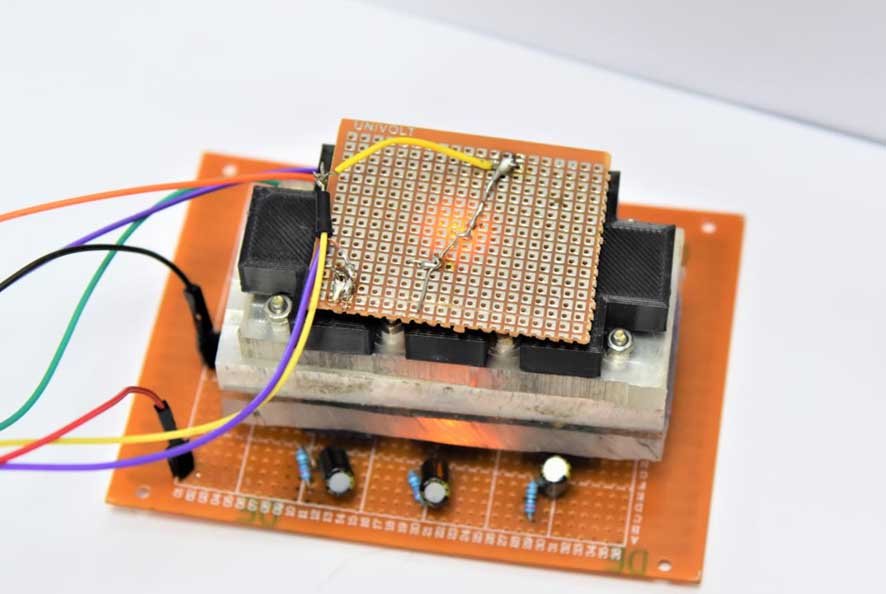
New Delhi: Researchers at the Indian Institute of Science (IISc) and the Indian Space Research Organisation (ISRO) have developed a special modular, self-contained device to carry out biological experiments in outer space using microorganisms. 

In a study published in ActaAstronautica, the team showed how the device can be used to activate and track the growth of a bacterium called Sporosarcinapasteurii over several days, with minimal human involvement. 

Understanding how microbes behave in extreme environments could provide valuable insights for human space missions such as ‘Gaganyaan’, India’s first crewed spacecraft. In recent years, scientists have been increasingly exploring the use of lab-on-chip platforms ‒ which combine many analyses into a single integrated chip ‒ for such experiments. But there are additional challenges to designing such platforms for outer space when compared to a laboratory on the ground. 

“It has to be completely self-contained,” points out Koushik Viswanathan, Assistant Professor in the Department of Mechanical Engineering and a senior author of the study. “Besides, you can’t simply expect the same operating conditions as you would in a normal laboratory setting. You can’t have something that guzzles 500W of power, for example,” Viswanathan explains.

The device developed by the IISc and ISRO team uses an LED and photodiode sensor combination to track bacterial growth by measuring the optical density or scattering of light, similar to spectrophotometers used in the laboratory. It has separate compartments for different experiments. Each compartment or ‘cassette’ consists of a chamber where bacteria ‒ suspended as spores in a sucrose solution ‒ and a nutrient medium can be mixed to kickstart growth, by clicking on a switch remotely. Data from each cassette is collected and stored independently. Three cassettes are clubbed into a single cartridge, which consumes just under 1W of power. The researchers envision that a full payload that could go in a spacecraft will contain four such cartridges capable of carrying out 12 independent experiments. 

The team also had to ensure that the device was leak-proof and unaffected by any change in orientation. “This is a non-traditional environment for the bacteria to grow. It is totally sealed and has a very small volume. We had to see whether we would get consistent [growth] results in this smaller volume,” says Aloke Kumar, Associate Professor in the Department of Mechanical Engineering, and another senior author.

Among other things, the researchers had to make sure that the LED going on and off will not generate much heat, which can change the bacterial growth characteristics. Using an electron microscope, the researchers were able to confirm that the spores grew and multiplied into rod-shaped bacteria inside the device, as they would have under normal conditions in the laboratory. 

“Now that we know this proof-of-concept works, we have already embarked on the next step ‒ getting a flight model [of the device] ready,” says Viswanathan. This would include optimising the physical space that the device can take up and its performance under stresses such as vibration and acceleration due to gravity. 

The device can also be adapted for studying other organisms such as worms, and for non-biological experiments, the researchers say. “The whole idea was to develop a model platform for Indian researchers,” explains Kumar. “Now that ISRO is embarking on an ambitious human space mission, it has to come up with its solutions, made at home,”  Kumar concludes. (India Science News)
Science, Tech Tags:‘Gaganyaan’, acceleration, biological experiments, device, electron microscope, gravity., human space mission, IISc, Indian Institute of Science, Indian Space Research Organisation, ISRO, lab-on-chip, LED, microorganisms, optical density, outer space, photodiode sensor, Spacecraft, spectrophotometer, sucrose

Post navigation

Previous Post: Disability and difficulties only stop those who let them. Alma Chopra rises above them
Next Post: Airgunkart – a one-stop-shop for a wide range of air guns and archery products and equipment

More Related Articles

Prakash Kumar Singh and CMAX Solutions: Building Technology Around Real Business Needs Tech
AI in Agencies: The Real Opportunity Is Not More Content, but More Capacity Tech
CIMET Brings AI-First Hiring to Jaipur With the City’s First AI Engineering Hackathon Tech
How to Build Stronger Data Protection with Kingston IronKey Tech
How Rentio Is Helping Businesses Meet Their Changing IT Equipment Requirements Tech
India Tightens Safety Norms for Household & Commercial Electrical Appliances: What It Means for Buyers and Sellers Tech

Leave a Reply Cancel reply

Your email address will not be published. Required fields are marked *

Categories

  • Agriculture
  • Apps News
  • astrology
  • Automobiles
  • Business
  • Education
  • Entertainment
  • Environment
  • Fashion & Beauty
  • Finance/Money
  • Food
  • Gadgets
  • Health & Fitness
  • LifeStyle
  • National
  • Photography
  • Politics
  • Press Release
  • Regional News
  • Religion
  • Science
  • Social Work
  • Sports
  • Tech
  • Travel
  • Uncategorized
  • World
  • Wow Personality

Recent Posts

  • Prakash Kumar Singh and CMAX Solutions: Building Technology Around Real Business Needs
  • Neuhof School Band Wins Yamaha Teens Rock 2026 Grand Finale, Celebrating India’s Young Music Talent
  • PracticeStacks Is Reimagining How Modern CA Firms Manage and Grow
  • Astropreach: Reimagining the Way People Understand Their Kundali
  • Dr. Pushpendra Pratap Singh Champions People-First, Technology-Led Supply Chains as Chief Guest

Ace Entrepreneur actor artificial intelligence Astrology author Bangalore Bengaluru Blockchain technology business Content Creator COVID-19 Cryptocurrency Delhi digital marketing Dubai education entrepreneur Fairplay Gujarat Gurugram health Hyderabad IIT Delhi Indian Institute of Technology influencer Influencerquipo Kingston Technology K Raheja Corp Homes Lotus Herbals memory products and technology solutions Mumbai Music Industry Nidarshana Gowani Noida photography producer Pune real estate Shan Se Entertainment Shantanu Bhamare Social Activist Social media Surat TTK Prestige WBR Corp

Copyright © 2026 The Medium News.

Powered by PressBook Blog WordPress theme